The Capoeira !
Capoeira is a culture.
A way of being.
A all people experiences of life.
A fight that comes from the thirst of freedom.
A will to create and invent a better life.
There is its great value.
Capoeira is fighting while playing. It's playing while fighting.
Capoeira is a school that teaches us with pleasure and joy that freedom is a good will
to be conquer in the "Roda" of life.
The history of Capoeira !
In the colonial time in Brazil, the back slaves, forbidden of any king of liberty,
found a way to unsure the survival of their culture through their body and soul.
This oppressive situation wasn't enough to erase their will to exist through the dance,
the food, the music and the religion, those black people have recreated their cultural world.
Bereaved from everything, the slaves only had their body to use as a tool for freedom.
The " Capoeiras " were land of dust with law vegetation where the slaves were training.
The fight's name probably comes from it.
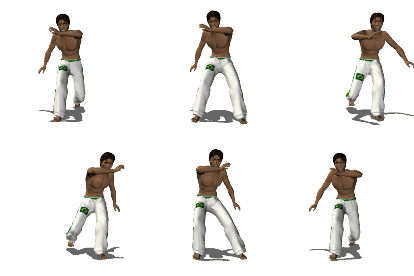
Their moves, almost acobatic, like a dance, were not seen as fight but like a salve game. The " ginga " was seen like dance step
that prepared the body for the moves " glopes ".
The musical instruments gave the rhythm to the game and warn of the arrival of the master.
The moves then changed to an armless dance.
The Capoeira has been, for many years, the fighting instrument of the black slave against his master.
After the slavery's abolishment, the Capoeira was forbidden for many years until it been acknowledged as a cultural event.
Today, it's Brazil's national sport.
Smart and elegant, the game of Capoeira was preserved and taught by great masters of Brazilian culture such as Pastinha,
Bimba, Valdemar da Liberdade, Traira, Totonho de Maré, Caiçara, Aberrê, Cobrinha Verde, Dois de Ouro, Bòbò, Canjiquinha,
Paulo dos Anjos, João Grande, João Pequeno,
Noronha, Gigante, Bigodinho, Boca Rica, Gato, Leopoldina, Miguel Machado and many more.
The musical instruments !
The " roda de capeoira " is rhythm but the musical instruments.
In a Roda you can find, 3 Berimbaus (Gunga, Médio and Viola), 2 Pandeiros, 1 Atabaque and 1 Agogô.
Berimbau : Percussion instrument, it looks like a bow with a tight steel line,
at the bottom you can find the " Cabaça " witch is used as a drum.
The " Baqueta " (the stick) and the " Dobrão " (the stone) touch the steel line and the " Cabaça "
is moved on and out the player's stomach witch make different sounds.
Pandeiro : Percussion instrument, goat skin is tighten and hold by wood made framework in a circle form.
The player hits it with his hand and it makes different sounds.
Atabaque : Drum made with animal skin and tighten by an iron circle put on a structure made of wood.
The hands on the skin make distinct sounds.
Caxixi : Instrument that looks like small straw baskets, used as " Chocalho " to mark the rhythm. Used with the Berimbau.
Agogô : Percussion instrument made with metal, it has two cones that when there are touch by a metal straw makes different sounds.
The Berimbau Gunga gives the rhythm to follow, like a basic.
The Berimbau Médio plays also like a basic but backward compare to the Gunga.
The Berimbau Viola it plays freely in free style.
The percussion instrument go along with the Berimbaus.
It existe different Toques in the Capoeira, they are played in diefferent moment in a Roda :
" Angola ", " São Bento pequeno ", " São Bento grande ", " São Bento grande regional ", " Amazonas ", " Cavalaria ",
" Iuna ", " Santa Maria ", " Benguela ", " Idalina ", " Barravento " et " Samba de roda ".
The Roda !
In a " Roda Régional ", the Capoeirites, stay up in circle and clap hands.
In a " Roda de Angola ", they sit down, they don't clap hands and they wait the end of the Ladainha to sing and respond.
The Capoeiristas greet each other every time they come in or out of the Roda, it a sign of respect to their opponent.
They greet the Berimbau and the protecting spirits.
To begin a game, the 2 Capoeiristas who are gonna start go to the instruments (Bateria) and kneel down to the Berimbau.
The game starts when the Corrido starts.
The Berimbau determine the music and the speed of a game. Usually it starts slow and ends fast.
In a " Roda Régional " it is permitted to buy a game, that means the players can come in the game when they want or
even one by one and they don't necessarily have to kneel down to the Berimbau.
The songs !
There is different sort of song : " ladainhas ", " chulas ", " Quadras "
and " corridos ".
The Quadras and Ladainhas are used to initiate the Roda.
The Chula is a welcome sing by everyone.
The Corridos are singing during the Roda and usually have short lyrics.
Capoeira's song tell many stories :
They can pay tribut and relate ancient Capoeiristas's adventures, talk about slavery and it's abolishment in 1888,
about Paraná's war, as well as actual things that happen in life and in the Roda, in fact,
Capoeira's songs are and open door to creativity and the liberty or talking.
Back to the main page !

